
Trees
There are many reasons to add trees to your garden space. Fruit bearing trees provide food for you and for wildlife, shade trees provide habitats for lots of animals and cut energy costs, and flowering trees improve property value and attract pollinators. No matter what you're in the market for, we have what you're looking for!! If you're not sure what you are looking for, one of our highly knowledgeable staff is always here to help you choose the perfect tree for your space!
*In an effort to give an accurate representation of what these trees will grow into, we have used royalty-free web images, and we do not own these photos. If you would like us to send photos of the actual trees we have on hand, please email us your request.*

Diospyros kaki Pictured: Fuyu

Punica granatum Pictured: Wonderful Pomegranate

Pyrus pyrifolia Pictured: Hosui Asian Pear

Pyrus Pictured: Bartlett Pear

Prunus persica Pictured: Elberta Peach

Prunus

Prunus spp Ornamental plum trees have much to offer the landscape; they are small, blooming deciduous trees, and many varieties have attractive purple foliage that appears after the blossoms have faded. Pictured: Krauter Vesuvius Ornamental Plum

Malus domestica Pictured: Yellow Delicious Apple

Prunus persica 'Pink Cascade' This arching and semi-cascading form features large bright pink flowers all along the bare branches that will brighten any garden space!

Ornamental cherry trees are known for their explosion of showy flowers in the spring. Pictured: Weeping Yoshino Cherry

Juniperus virginiana Adds year-round greenery and texture to the landscape.

Cedrus atlantica glauca 'Pendula' An evergreen conifer, the drooping, twisted branches filled with powdery blue needles are sure to catch the eye.

Cupressus × leylandii Leyland cypress is an evergreen tree with an upright, columnar habit and with foliage almost to the ground.

Cercis canadensis These trees have small, showy blooms that form clusters that pop up all over the tree and heart-shaped leaves that shimmer in the sun. Pictured: Forest Pansy Redbud

Quercus virginiana An live oak is a massive, picturesque, wide-spreading tree with magnificent horizontal and arching branches that form a broad, rounded canopy.
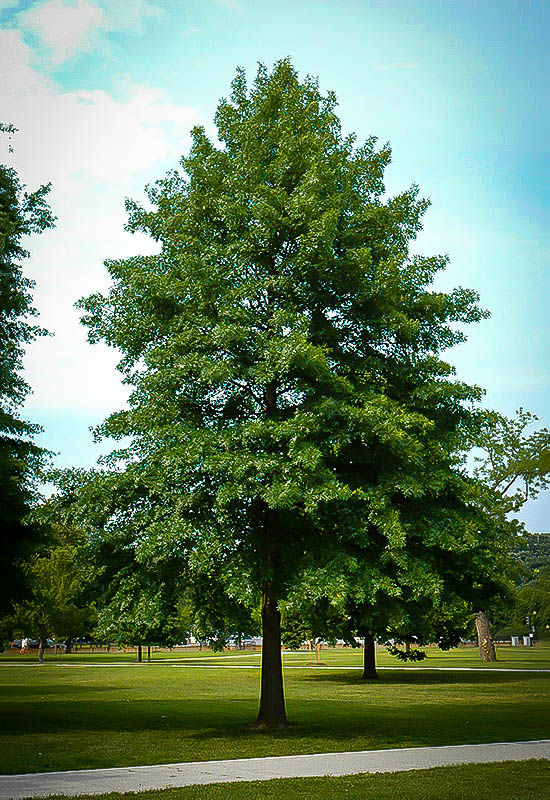
Quercus palustris Pin oak is one of the most commonly used landscaping oaks in its native range due to its ease of transplant, relatively fast growth, and pollution tolerance.

Quercus texana A strong and adaptable oak that provides summer shade and nice fall foliage.

Quercus acutissima An attractive, durable shade tree with leaves that open a brilliant yellow to golden yellow color in the spring, turning dark lustrous green in summer and yellow to golden brown in the fall.

Quercus nigra Highly beneficial to wildlife for shelter, habitat, and food source.

Quercus phellos Its fine texture contrasts well with more coarse-textured trees and its pyramidal crown and long straight trunk make it an excellent shade tree.

Quercus alba White oak is a massive, long-lived stately tree with wide spreading horizontal branches and wine-red fall color.

Malus hybrida Produces an abundance of white, fragrant flowers, while in summer the tree produces small green fruit that turns a bright red color in the fall.

Malus Hybrida Prized for its showy, deep-pink blossoms and dark red fruit.

Acer rubrum A cultivar of the Red Maple, this tree boasts showstopping red color and requires minimal attention.

Acer x freemanii A hybrid of the red and silver maples, this tree displays the rapid growth habit of the silver maple with the vibrant fall color and hardiness of the red maple.

Salix babylonica This graceful giant is known for its open crown of wispy, ground-sweeping branches and long, slender leaves.

Prized for their large flowers that perfume the air with a sweet fragrance, magnolia trees are truly one of the joys of the spring season!

Crape myrtle trees and shrubs provide year-round interest with their showy flowers in the summer months, their attractive, colorful fall foliage, and unique exfoliating bark in the winter.

This fast growing evergreen features lacy, silvery-blue foliage and a natural pyramidal shape.

Pinus taeda Highly adaptable evergreen with long, thin needles and scaly bark.

Easily identified by its long, graceful leaves and curly, contorted branches that become especially apparent during the winter.

Not to be confused with the tulip tree, the tulip magnolia is a deciduous tree that bears an abundance of fragrant, cup-shaped, pink flowers before foliage emerges in spring.

Acer palmatum Japanese maple trees are known for their spectacular colors and elegant shapes, adding vibrancy and balance to the landscape. Pictured: 'Bloodgood'

Prunus persica Abundant double ruby-pink blooms in spring followed by dark burgundy foliage with wavy leaves.

*We do not own this image* Ulmus x 'Frontier' Striking red-purple fall color and a pyramidal shape with smooth grey-green bark.

Salix caprea Admired for its strong, spreading, upright stems, colorful autumn leaves and iconic purplish-brown catkins that appear in late winter/early spring.